
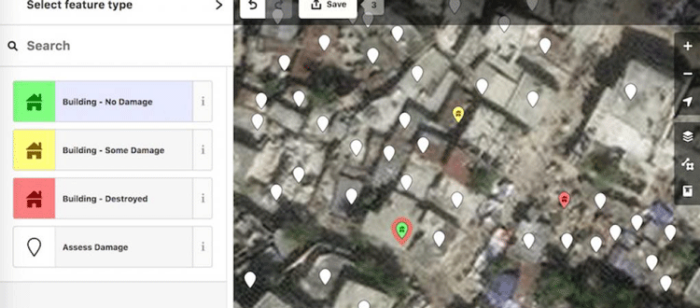
The Humanitarian OpenStreetMap Team (HOT) has partnered with several academic and outreach groups in order to research better crowdsourcing methods for collecting information on the impacts of natural disasters. HOT recently launched three formal research experiments on crowdsourced damage assessment and is seeking volunteers interested in participating. All three experiments have the collective aim of developing a better understanding of how volunteers determine building damage from viewing satellite imagery.
Volunteers who are interested in help HOT with its Crowdsourced Damage Assessment research have three options:
There are also area-based surveys concerning damage ranks and damage comparisons that involve queries like rating the level of building damage in an area and comparing damage in two different areas.
The research experiments will continue for the next year until July 1, 2018 and HOT is partnering with the Stanford Urban Resilience Initiative (SURI), the World Bank’s Global Facility for Disaster Reduction and Recovery (GFDRR), Heidelberg University, and the University of Colorado, Boulder.
More: Call For Participation: Crowdsourced Damage Assessment

