
The rise of the suburbs and the declining urban city which dominated much of American growth in the last half of the Twentieth century is reversing course. This reverse migration back into urban centers was named the Great Inversion in Alan Ehrenhalt’s book, “The Great Inversion and the Future of the American City.“
To statistically analyze this migration pattern, William H. Frey Senior Fellow, Metropolitan Policy Program at the Brookings Institution, analyzed new data released by the Census Bureau and found that:
[T]he numbers show that many cities have gained more people in the three-plus years since the 2010 Census than they gained for the entire previous decade. This includes three of the five largest cities, New York, Philadelphia and Chicago (which lost population in the previous decade). Among the 25 largest cities, nine are already ahead of their previous decade’s gains, including Dallas, Denver, Memphis, San Francisco, San Jose and Washington, D.C. (See table)
Frey further noted that:
In the city versus suburb realm, the new numbers once again affirm a reversal that counters decades of suburban-dominated regional growth among metro areas with more than 1 million people. Now, for three years running, primary cities are growing faster than their suburbs (See Figure 2).
From 2000 to 2010 as with many prior years, suburban growth substantially exceeded that of primary cities. This changed in the each of the three subsequent years. In 2012-2013, 19 of the 51 major metropolitan areas showed faster primary city than suburb growth including New York, Washington D.C., Denver and Seattle. (See table)
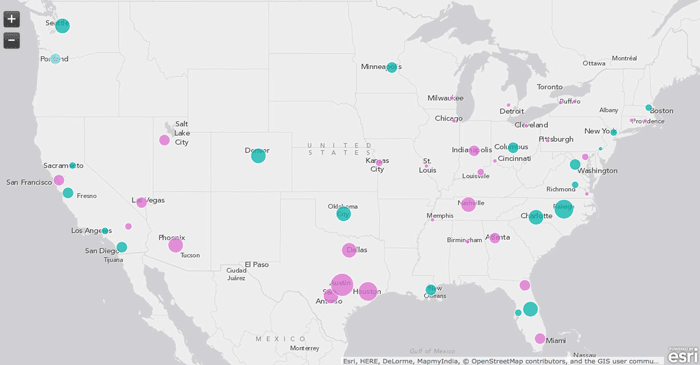
Richard Florida at Atlantic’s CityLab visualized the same data Frey analyzed as an ArcGIS Online map. The map shows each urban/surburban area color coded with graduated symbol. The size of the circle indicates the rate of growth and pink circles are where the suburbs grew faster and green where the cities grew faster. One city, Portland, experienced equal rates of growth in both the suburb and urban areas, and is symbolized in blue. Click on each city/suburb location for more growth statistics.
References
South, West Have Fastest-Growing Cities, Census Bureau Reports; Three of Top 10 are in Texas Capital Area. US Census Press Release. May 22, 2014.
Where Cities Are Growing Faster Than Their Suburbs. Richard Florida. The Atlantic. June 23, 2014.
Will This Be the Decade of Big City Growth? William H. Frey. Brookings Institute. May 23, 2014.
