
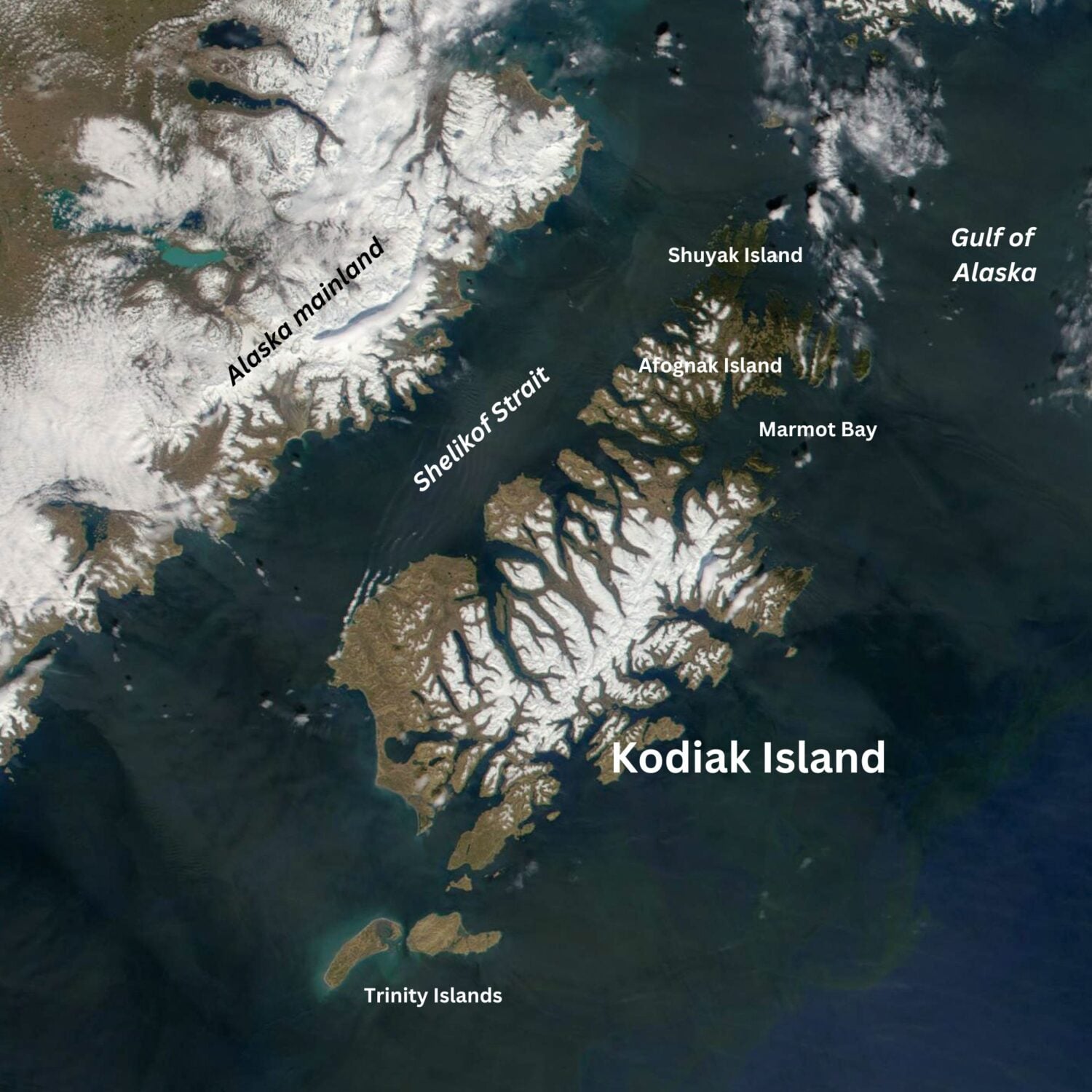
Lying along the south coast of the state, Kodiak Island is the largest island in Alaska with an area of 3,588 square miles (9,293 square kilometers). Kodiak Island is also the second largest island in the United States—Hawaii Island (aka the “Big Island”) is the largest.
Kodiak Island’s topography is diverse. It features rugged mountains, dense forests, and numerous rivers and lakes. The island’s highest point is Koniag Peak, which is approximately 4,265 feet (1,300 meters) above sea level.
The southern part of Kodiak Island is drier and cooler with a tundra ecosystem made up of sedges, mosses, heaths, and grasses. The northern and eastern areas of Kodiak Island have mountainous terrain with forests.

The Kodiak National Wildlife Refuge covers about two-thirds of the island. Kodiak National Wildlife Refuge was established in 1941 by President Franklin D. Roosevelt and covers 1,990,418 acres in the Kodiak Archipelago.
Largest brown bears in the world
Kodiak Island is famous for its eponymous bears. The Kodiak brown bear (Ursus arctos middendorffi) is the largest brown bear in the world with males growing to as large as 10 feet when standing on their rear legs.
This subspecies of brown bear exists only in the Kodiak Archipelago. Kodiak Island also has the highest density of brown bears. The island’s Kodiak bear population is about 3,500 which translates into about 0.7 bears per square mile.

Wintering grounds for emperor geese
Kodiak Island is one of the wintering grounds for the emperor goose (Anser canagicus). Emperor geese overwinter along the Alaska Peninsula, the Aleutian Islands, and Kodiak Island.

Very few roads on Kodiak Island
Despite its size, there are only about 100 miles of roads on Kodiak Island. Most of these roads are found on the western side of the island.
Oldest Russian Orthodox Church in Alaska
The oldest Russian Orthodox church still in use in Alaska is found on Kodiak Island in Karluk. Built in 1888, Ascension of Our Lord Russian Orthodox Church is situated on the west coast of Kodiak Island. The current building replaced a previous church that was constructed some time in the 1700s. The church first introduced Russian Orthodox religious practices to the indigenous population, both blending with and replacing some of the Alutiiq/Sugpiaq cultural traditions.
