
The impacts of climate change on ecosystems and wildlife are becoming increasingly evident. Scientists are combining long-term climate records with animal movement data to better understand how wildlife responds to a warming world.
One adaptation observed among various animal species in response to above-normal temperatures is a shift in activity patterns, with animals that are normally diurnal, meaning active during the day, becoming more active at night.
Why some animals are becoming nocturnal with climate change
One reason for this shift is to avoid daytime heat, which can place significant stress on wildlife. As global temperatures rise, daytime conditions become increasingly inhospitable for many species. Excessive heat can lead to dehydration, heat exhaustion, and a decrease in the availability of food and water resources. In response, animals are adjusting their active hours, becoming more active at night when temperatures are cooler.
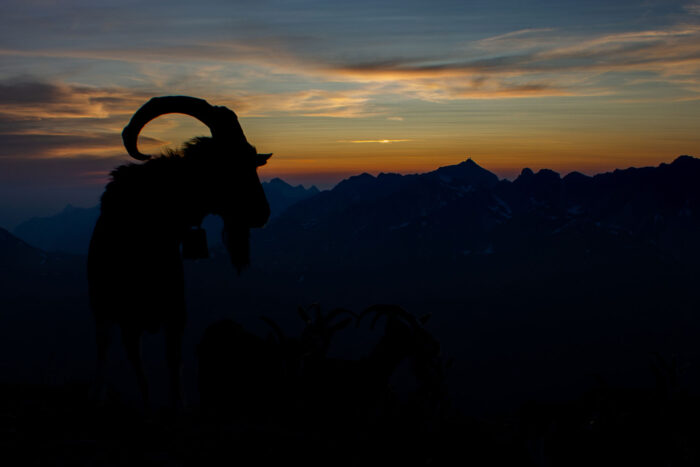
Led by researchers from the University of Ferrara, a recently published study in the Proceedings of the Royal Society B found that higher daytime temperatures were the primary driver behind a shift toward nighttime foraging by Alpine ibex. The study used GPS-trackers to map out the movements of 47 ibex (Capra ibex) in two protected areas located in the Gran Paradiso National Park in the northwestern Italian Alps.

The authors of the study concluded that especially on warmer days followed by brighter moonlight at night, the ibex shifted their foraging behavior to nighttime as a way to stay cooler. Increased moonlight improves foraging success for animals that rely on vision to find food and navigate steep, rocky terrain. Despite the increased risk of predation, ibex shifted toward greater nocturnal activity even in areas occupied by wolves (Canis lupus), their main predators.
The findings of this ibex study dovetail with previous research published in Ecological Monographs that explored how diurnal animals may respond to climate change by shifting more of their activity to nighttime hours.
Tradeoff between cooler conditions and increased risks
While shift to more nocturnal activities at night might help warm-blooded mammals escape daytime heat, it is not without other risks. Brighter moonlight conditions, while making it easier for some species to forage and navigate, also make prey more visible to nocturnal predators like wolves.
Not all animals are able to shift to more nocturnal activity as a response to climate change. A 2020 study published in Nature Ecology & Evolution of camera-trap data collected from 32 protected areas across southern Africa found that climate change is squeezing the adaptive window of intermediate-sized herbivores (100–550 kg), forcing them to forage during the hottest part of the day in order to avoid predation by lions who tend to be more active during the coolest parts of the day and at night.
Climate change isn’t the only human-related influence creating nocturnal shifts in animals
It’s not just warmer days that are driving a trend in typically diurnal animals becoming more active at night. A 2018 study by UC Berkeley researchers published in the journal Science found that animals living close to humans are more likely to become nocturnal to avoid human activity.
Analyzing data from 72 studies across six continents on 62 species of larger herbivores and carnivores, using GPS trackers, radio collars, remote cameras, and direct observations, researchers concluded that animals in areas with high human activity had an increase in nighttime activity. For example, an animal that normally was active 50% at night might increase this to 68% in areas with more human presence.
This nocturnal shift was consistent across different types of human disturbances, including hunting, hiking, mountain biking, and areas with roads, homes, and farms. The study’s lead author, Kaitlyn Gaynor, noted that animals react strongly to human presence alone, changing their natural behavior patterns. A 2019 study published in Movement Ecology, found a similar daytime avoidance by foraging black bears in the presence of human activity.
Conservation management needs to incorporate temporal shifts in animal activity
As temperatures continue to rise, shifts in the timing of animal activity may become increasingly common. While some species can avoid heat by becoming more active at night, others face competing pressures from predators, limited visibility, or biological constraints that make such adjustments difficult. Understanding these temporal shifts will become an increasingly important part of wildlife conservation and ecosystem management.
References
Brivio, F., Apollonio, M., Anderwald, P., Filli, F., Bassano, B., Bertolucci, C., & Grignolio, S. (2024). Seeking temporal refugia to heat stress: increasing nocturnal activity despite predation risk. Proceedings of the Royal Society B, 291(2015), 20231587. https://doi.org/10.1098/rspb.2023.1587
Levy, O., Dayan, T., Porter, W. P., & Kronfeld-Schor, N. (2019). Time and ecological resilience: Can diurnal animals compensate for climate change by shifting to nocturnal activity? Ecological Monographs, 89(1), e01334. https://doi.org/10.1002/ecm.1334
Veldhuis, M. P., Hofmeester, T. R., Balme, G., Druce, D. J., Pitman, R. T., & Cromsigt, J. P. (2020). Predation risk constrains herbivores’ adaptive capacity to warming. Nature Ecology & Evolution, 4(8), 1069-1074. https://doi.org/10.1038/s41559-020-1218-2
