

Although penguins are closely associated with Antarctica, only one of the world’s 18 penguin species naturally crosses into the Northern Hemisphere. The remaining species are found almost entirely south of the Equator, inhabiting coastlines and islands from Antarctic sea ice to the temperate coasts of South America, Africa, Australia, and New Zealand.
What are penguins?
Penguins are adapted to a life in the water. While penguins may move slowly on land, their flippers, webbed feet, and streamlined bodies make them fast swimmers. Penguins are among the fastest swimming birds in the world, with Gentoo penguins reaching underwater speeds of around 36 kilometers-per-hour (22 miles-per-hour).
Penguins have a darker outer body with white plumage on their undersides. Known as countershading, this type of camouflage helps to blend the penguin in the water. The penguin’s back blends in with the dark ocean waters when viewed by predators from above. The white underbelly of the penguin blends the bird with the sky to predators looking up at the penguin from below the surface of the water.

Smallest and largest penguins
Penguins range in size from the blue penguin (Eudyptula minor) which stands at about 33 cm (13 in) high to the largest penguins, the Emperor penguin (Aptenodytes forsteri) at 1.1 m (3 ft 7 in) tall.
How Many Species of Penguins are There?
There are about 17 to 19 species of penguin in the world (the number varies due to disagreement among taxonomists). For example, some taxonomists consider the white-flippered penguin (Eudyptula novaehollandiae) a separate Eudyptula species, why others consider it to be a subspecies of the little penguin (Eudyptula minor). Other authorities consider the macaroni penguin (Eudyptes chrysolophus) to be the same species as the royal penguin (Eudyptes schlegeli). The International Ornithological Committee (IOC) officially recognizes 18 penguin species.
All penguins belong to the subfamily Spheniscinae. There are six genera of penguins.
- The genus Aptenodytes includes two species: the King Penguin and the Emperor Penguin.
- Pygoscelis comprises three species: the Adelie Penguin, the Chinstrap Penguin, and the Gentoo Penguin, along with several subspecies of Gentoo.
- Eudyptula contains the Little Penguin and its five subspecies.
- Spheniscus includes four species: the Galapágos Penguin, the Humboldt Penguin, the Magellanic Penguin, and the African Penguin.
- Megadyptes is represented by a single species, the Yellow-eyed Penguin.
- The genus Eudyptes includes six species: the Macaroni Penguin, the Royal Penguin, the Northern Rockhopper Penguin, the Southern Rockhopper Penguin, the Fiordland Penguin, the Snares Penguin, and the Erect-crested Penguin, with subspecies within the Rockhopper group.
List of penguin species and where they live
The International Ornithological Committee (IOC) recognizes 18 species of penguin and 12 subspecies. Penguins are found across much of the Southern Hemisphere, with breeding colonies occurring on Antarctica, the Antarctic Peninsula, subantarctic islands, and the southern coasts of South America, Africa, Australia, and New Zealand.
Why are penguins found mostly in the Southern Hemisphere?
Penguin distribution is shaped more by the oceans than by latitude alone. Nearly all penguin species depend on cold, nutrient-rich waters that support the marine food webs they rely on.
Ocean currents such as the Humboldt Current along the west coast of South America and the Cromwell Current near the Galápagos Islands bring nutrient-rich water to the surface, supporting abundant populations of fish, squid, and krill. This reliable food supply explains why penguins are found along coastlines and islands across a wide range of climates, from Antarctic sea ice to the temperate shores of South America and even the tropical Galápagos Islands.
While many people associate penguins with snow and ice, most species actually live outside Antarctica. Some inhabit subantarctic islands, while others thrive along temperate coastlines where cold, nutrient-rich ocean currents provide abundant fish, squid, and krill. For example, Magellanic penguins live in the temperate coastal regions of southern South America. The Humboldt penguin resides along the temperate coasts of Peru and Chile.

Antarctica and Penguins
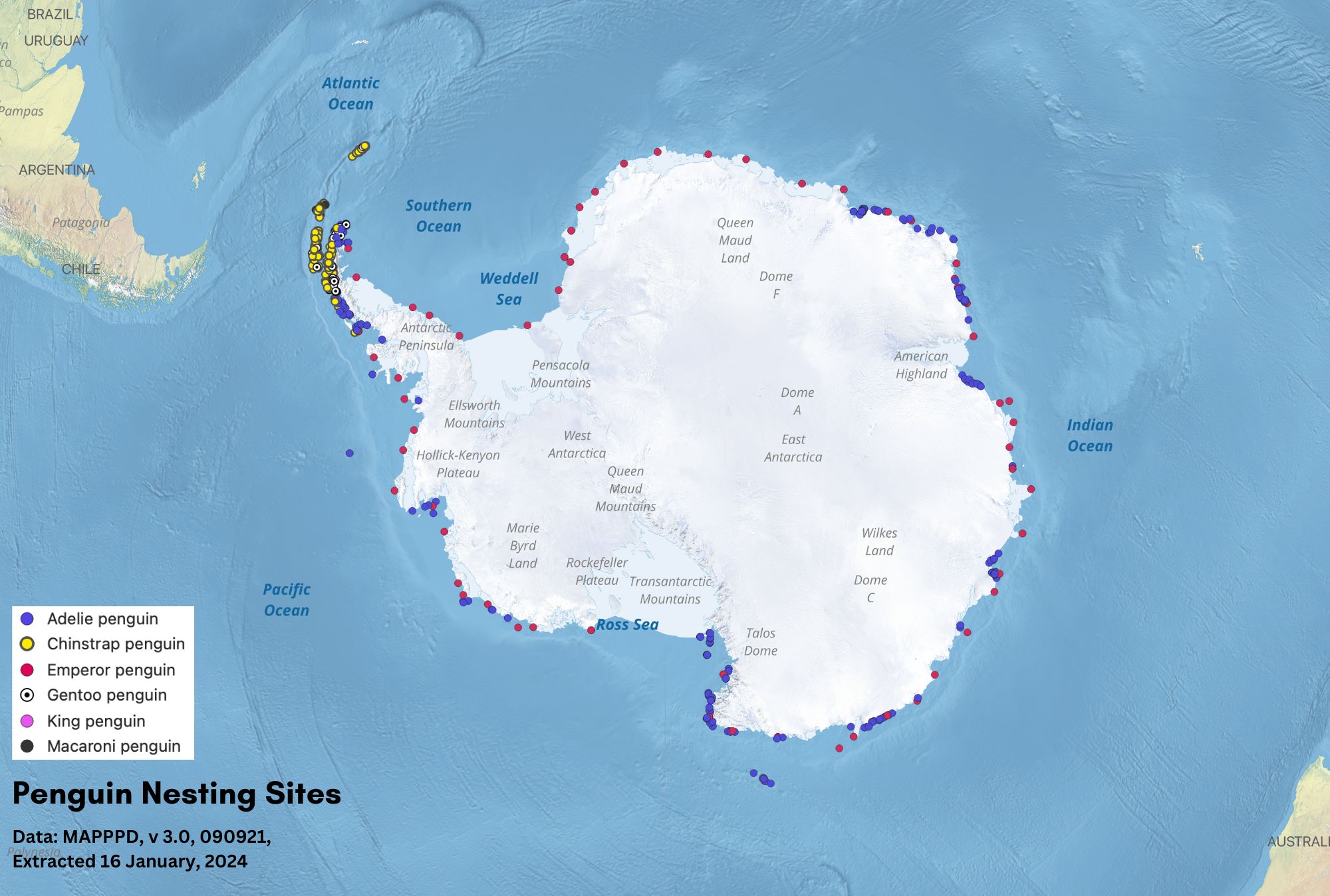
Penguins are among the most abundant breeding birds in Antarctica. There are two species of penguins that live year round on Antarctica: Emperor penguin (Aptenodytes Forsteri) and the Adélie penguin (Pygoscelis Adéliae).
Three other species breed on the northern tip of the Antarctic Peninsula: Gentoo penguin (Pygoscelis Papua), Marconi penguin (Eudyptes chrysolophus), and the Chinstrap penguin (Pygoscelis Antarctica).
Only one species of penguin lives north of the Equator
The Galápagos penguin is the only penguin species whose natural range extends into the Northern Hemisphere. The Galápagos penguin is also the only penguin to breed entirely in a tropical climate. About 95% of the breeding population of these penguins are found on the islands of Fernandina and Isabela.
The Galápagos penguin colony on the northern tip of Isabela juts into the Northern Hemisphere. The cold Humboldt and Cromwell currents bring nutrient-rich water to the surface, supporting anchovies, sardines, squid, and other prey that sustain the Galápagos penguin despite its tropical location.
Most Numerous Species of Penguin
With an estimated 12 million breeding pairs the Macaroni penguin is considered one of the most numerous species of penguins. Macaroni penguins form huge colonies that can number into the hundreds of thousands.
Using geospatial technologies to count penguins
In addition to field surveys, researchers are able to use geospatial and remote sensing technologies to map and count penguins. For example, scientists from Stony Brook University led a study, published in Scientific Reports in 2018 that used ground counts and drone technology to count 751,527 pairs of Adélie penguins on Danger Island near the tip of the Antarctic Peninsula.

In 2014, the same Stony Brook University researchers adapted methodologies to use Landsat 7 satellite imagery to estimate Antarctic penguin populations by identifying guano stains. This method helps locate penguin colonies, which are difficult to reach due to unstable sea ice. Using remote sensing has led to the discovery of new colonies, notably in the Danger Islands, and significantly increased penguin counts. Recent surveys discovered 166,000 additional penguins on Brash Island, 23,000 on Earle Island, and 7,000 on Darwin Island.
References
Borowicz, A., McDowall, P., Youngflesh, C., Sayre-McCord, T., Clucas, G., Herman, R., … & Lynch, H. J. (2018). Multi-modal survey of Adélie penguin mega-colonies reveals the Danger Islands as a seabird hotspot. Scientific reports, 8(1), 1-9. https://doi.org/10.1038/s41598-018-22313-w
Gill F, D Donsker & P Rasmussen (Eds). 2024. IOC World Bird List (v14.1). doi : 10.14344/IOC.ML.14.1.
Hickcox, R. P., Jara, M., Deacon, L. A., Harvey, L. P., & Pincheira-Donoso, D. (2019). Global terrestrial distribution of penguins (Spheniscidae) and their conservation by protected areas. Biodiversity and Conservation, 28, 2861-2876. https://doi.org/10.1007/s10531-019-01801-z
Lynch, H. J., & Schwaller, M. R. (2014). Mapping the abundance and distribution of Adélie penguins using Landsat-7: first steps towards an integrated multi-sensor pipeline for tracking populations at the continental scale. PLoS One, 9(11), e113301.
