
As glaciers slowly move across the landscape, they grind the underlying rock into an extremely fine powder called glacial flour, or rock flour. Gravity causes glaciers to flow downhill over time, and the immense weight of the ice presses against the bedrock beneath it. As the glacier moves, friction scrapes and breaks apart the rock, producing tiny mineral particles that are easily carried away by glacial meltwater.
Much of this fine sediment is transported into downstream lakes. Because glacial flour particles are so small, they remain suspended in the upper, sunlit portion of the water known as the photic zone. As sunlight passes through the water, the suspended particles scatter blue and green wavelengths of light while longer red, orange, and yellow wavelengths are largely absorbed. This scattering gives many glacier-fed lakes their distinctive turquoise appearance.
The turquoise color is often most intense during the summer melt season, when fresh glacial flour is continuously delivered into the lake. The distinctive turquoise color makes glacier-fed lakes easy to identify in satellite imagery and is often one of the clearest visual indicators of glacial meltwater entering a lake.
Not every glacier-fed lake appears turquoise. Lakes that receive little suspended glacial flour often appear blue rather than turquoise because there are fewer mineral particles available to scatter sunlight.
Tustumena Lake
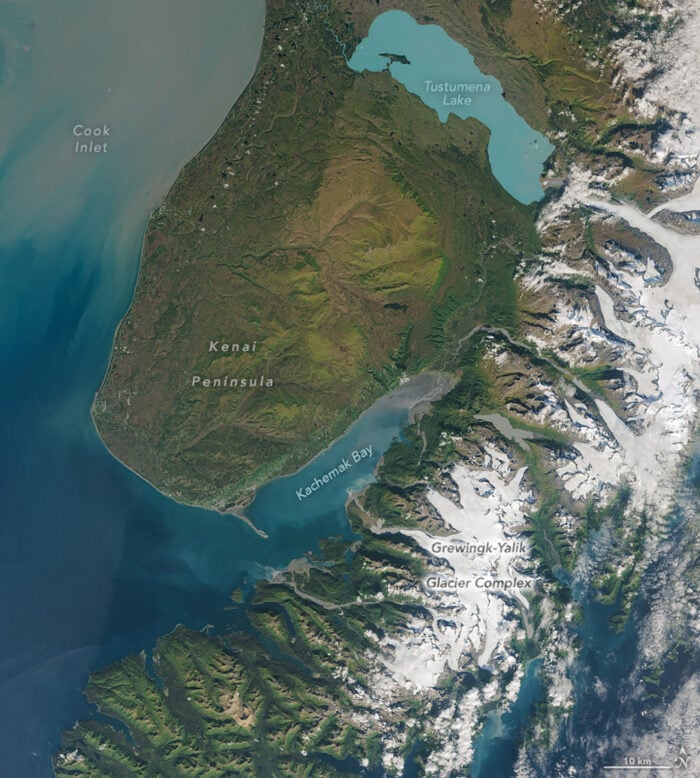
Tustumena Lake, located on the Kenai Peninsula, is Alaska’s eighth-largest lake. Fed by meltwater from Tustumena Glacier, which originates in the Harding Icefield, the lake contains suspended glacial flour that gives it a striking turquoise color, as seen in this Landsat 8 image captured on September 20, 2024.

Turquoise lakes on South Island in New Zealand
Several alpine lakes on South Island are also known for their vivid turquoise color, including Lake Pukaki, Lake Tekapo, Lake Ōhau, and Lake Benmore. These lakes receive glacial flour carried by meltwater rivers. Lake Tekapo is fed by meltwater from the Classen Glacier, Grey Glacier, and Godley Glacier via the Godley River. Lake Pukaki receives glacial runoff from the Tasman Glacier and Hooker Glacier through the Tasman River.

