
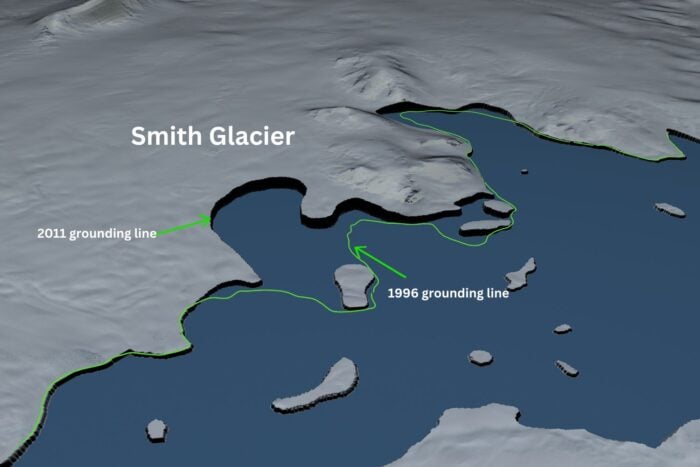
Grounding lines are the boundaries where glaciers and ice sheets transition from resting on solid ground to floating on seawater. They control the flow of ice into the ocean and are central to understanding ice sheet stability and future sea-level rise.
What are grounding lines?
A grounding line marks the point where a glacier or ice sheet lifts off the bedrock and begins floating on seawater. Scientists determine grounding lines using the flotation criterion, which compares the weight of the ice to the buoyancy of seawater. If the ice is thick enough, it remains grounded. If it becomes thin enough to float, the grounding line shifts inland.
The shape of the bedrock beneath a glacier plays an important role in grounding line stability. Glaciers with retrograde beds, where the bedrock slopes downward farther inland, are particularly vulnerable to retreat. As the grounding line retreats inland over this downward-sloping bedrock, warm ocean water can reach thicker ice, increasing melting and accelerating further retreat. This can lead to feedback loops that accelerate the flow of ice into the ocean and further destabilize ice sheets.
Why grounding lines are critical for ice sheet stability
The grounding line regulates the flow of ice from glaciers into the ocean. Much of the ice loss occurs around these boundaries due to warm ocean water that melts the ice from underneath.
Warm ocean water melts the underside of floating ice, causing the grounding line to retreat. As the grounding line moves inland, ice shelves lose mass and become less able to slow the glaciers feeding them. Without that support, the glaciers accelerate toward the ocean and thin more rapidly, pushing the grounding line even farther inland. This creates a self-reinforcing feedback that accelerates ice loss.
Retreating grounding lines
West Antarctic Ice Sheet
The Amundsen Sea sector of the West Antarctic Ice Sheet is one region where grounding lines have retreated dramatically. Researchers used decades of radar data collected by the European Remote Sensing (ERS-1 and ERS-2) satellites to map changes in grounding line position across the Amundsen Sea sector. Analyzing data for Pine Island from 1992 to 2011 revealed the retreat of the grounding line of that glacier by 19 miles (31 kilometers). Thwaites Glacier retreated by 9 miles (14 kilometers) during the same time period.

Denman Glacier, East Antarctica
According to a study published in Geophysical Research Letters, researchers at NASA’s Jet Propulsion Laboratory and the University of California, Irvine (UCI) found that between 1996 and 2018, the grounding line on the western flank of Denman Glacier retreated about 5.4 kilometers (3.4 miles). Denman Glacier’s retrograde bed on its western flank makes it particularly vulnerable to accelerated retreat due to warmer ocean waters being able to penetrate further inland. Researchers estimate that a complete collapse of Denman Glacier could raise global sea levels by about 1.5 meters.

Monitoring and research of grounding lines
Advances in Earth observation technology have greatly improved scientists’ ability to monitor grounding lines. Satellite radar interferometry, using ESA’s Sentinel-1 mission and earlier European Remote Sensing satellites, allows scientists to map changes in grounding line position with unprecedented detail. NASA’s Operation IceBridge has further refined knowledge of the thickness of the ice and basal melting through airborne radar campaigns.
Robotic submersibles and satellite altimetry have also improved scientists’ understanding of the processes occurring beneath ice shelves. Together with airborne and satellite observations, these technologies have revealed rapid thinning beneath glaciers such as Smith Glacier, where some locations have lost hundreds of meters of ice thickness.
Because grounding lines mark the transition between grounded and floating ice, even relatively small changes in their position can affect the stability of entire glaciers and ice sheets. As satellite observations continue to improve, scientists are able to monitor these changes with increasing precision, providing important insight into how Antarctica and Greenland are responding to a warming climate.
References
Brancato, V., Rignot, E., Milillo, P., Morlighem, M., Mouginot, J., An, L., … & Prats‐Iraola, P. (2020). Grounding line retreat of Denman Glacier, East Antarctica, measured with COSMO‐SkyMed radar interferometry data. Geophysical Research Letters, 47(7), e2019GL086291.
Lynch, P. (2014, May 12). The ‘unstable’ west Antarctic ice sheet: A primer. NASA Jet Propulsion Laboratory (JPL).
