
Editorial: Most geographers either work for government agencies or do substantial business with them. That makes how those agencies are governed our business too. How a governing board holds itself accountable shapes how well the agency upholds its own policies and principles, and those policies and principles shape the work we do with it.
Our code, their code
For geographers, government is often both the client and the subject of our scrutiny. Government agencies employ nearly three-quarters of U.S. geographers and about half of cartographers and photogrammetrists.
Many geographers work as GIS professionals, and those who obtain a GISP are required to follow a code of ethics. The GIS Certification Institute’s Code of Ethics makes an important distinction: our first obligation is to society, not to the comfort of an employer. It asks us to do what is right, not just what is legal, and to speak up about unprofessional work. Following those principles can mean speaking uncomfortable truths in the interest of better care for society.
Similarly, a code of conduct is intended to be where a governing board writes down how it will treat the public and the agency it represents. Everything else flows from it. When those sitting on a governing board, like a Board of Directors or a Board of Supervisors, hold themselves to a high standard of caring, staff learn that the public’s concerns matter, warnings get answered, and problems get fixed. When directors don’t, everything downstream follows their lead.
When the public raises concerns
Take a moment to watch these statements by a director sitting on the board of the Midpeninsula Regional Open Space District, a special district in the San Francisco Bay Area, including calling members of the public names and asking staff to “get rid of her.”
Watch the video of an elected official’s remarks about members of the public
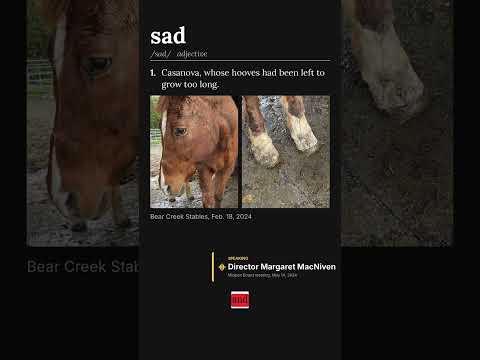
In her remarks at an October 22, 2025 board meeting, MacNiven was referring to me. Two days before that meeting, I had emailed the Board after members of the community had kept coming to me for months with concerns they said they were not comfortable raising themselves. In my email, which MacNiven incorrectly called a comment letter, I had closed with this: “I advise all directors to refer to the Board Code of Conduct for how to respectfully and appropriately engage with and respond to members of the public bringing legitimate issues forward that are well within the purview of this legislative body.” None of the other six directors spoke up in the meeting despite this clear violation of their code of conduct.
Open space done well, stables left behind
Midpen does some amazing things. Its preservation of tens of thousands of acres is laudable. It doesn’t just preserve open space; it actively studies and comes up with strategies to create wildlife linkages, like the wildlife crossing at Highway 17 that is currently being developed. Its docent program is, I think, best in class, with volunteers going through an intensive naturalist program so they can lead highly specialized themed hikes that are free for the public.
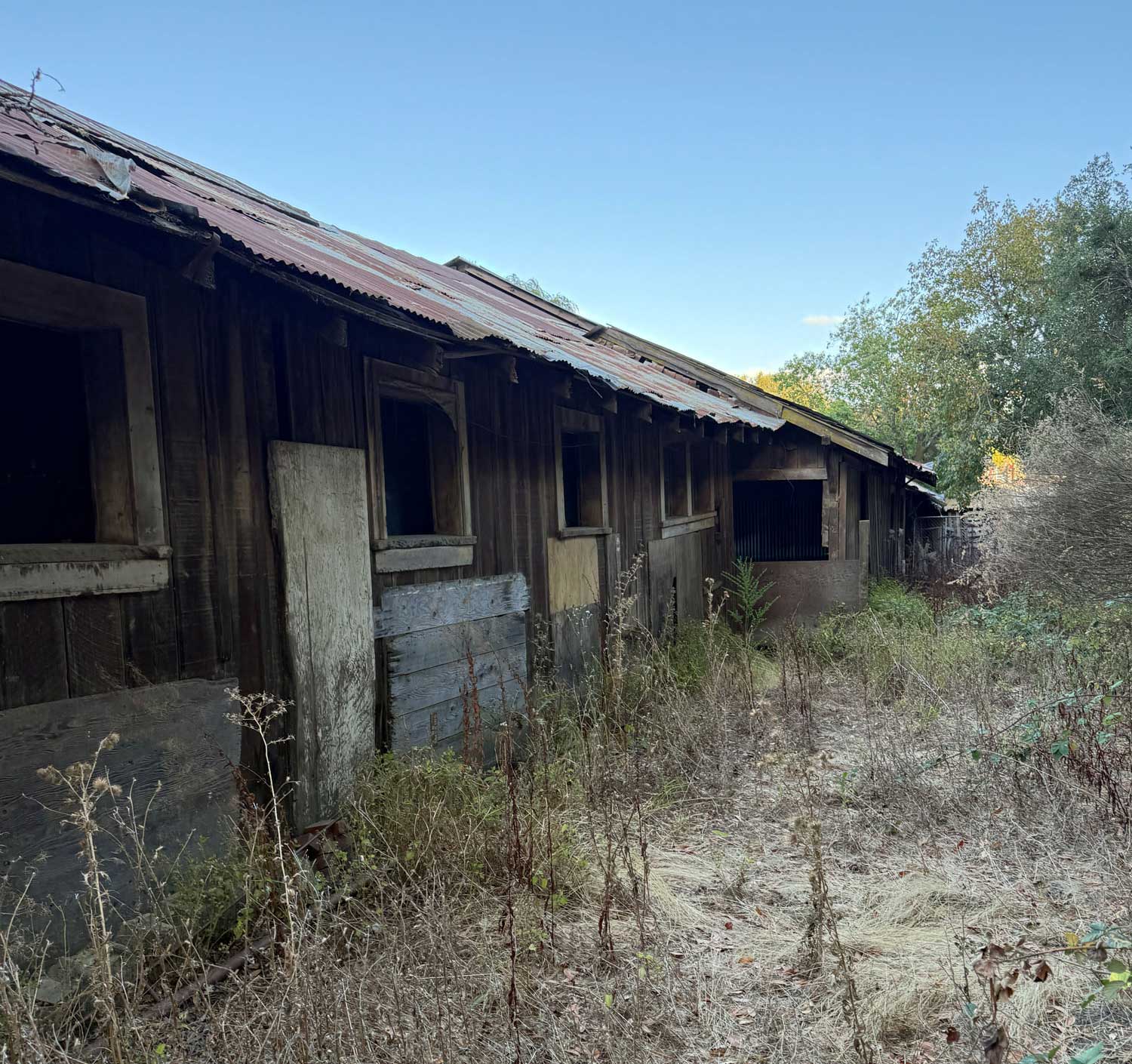
Where I have seen Midpen governance stumble, at the expense of animal welfare and public safety, is Bear Creek Stables, a horse stable Midpen owns in the Santa Cruz Mountains.
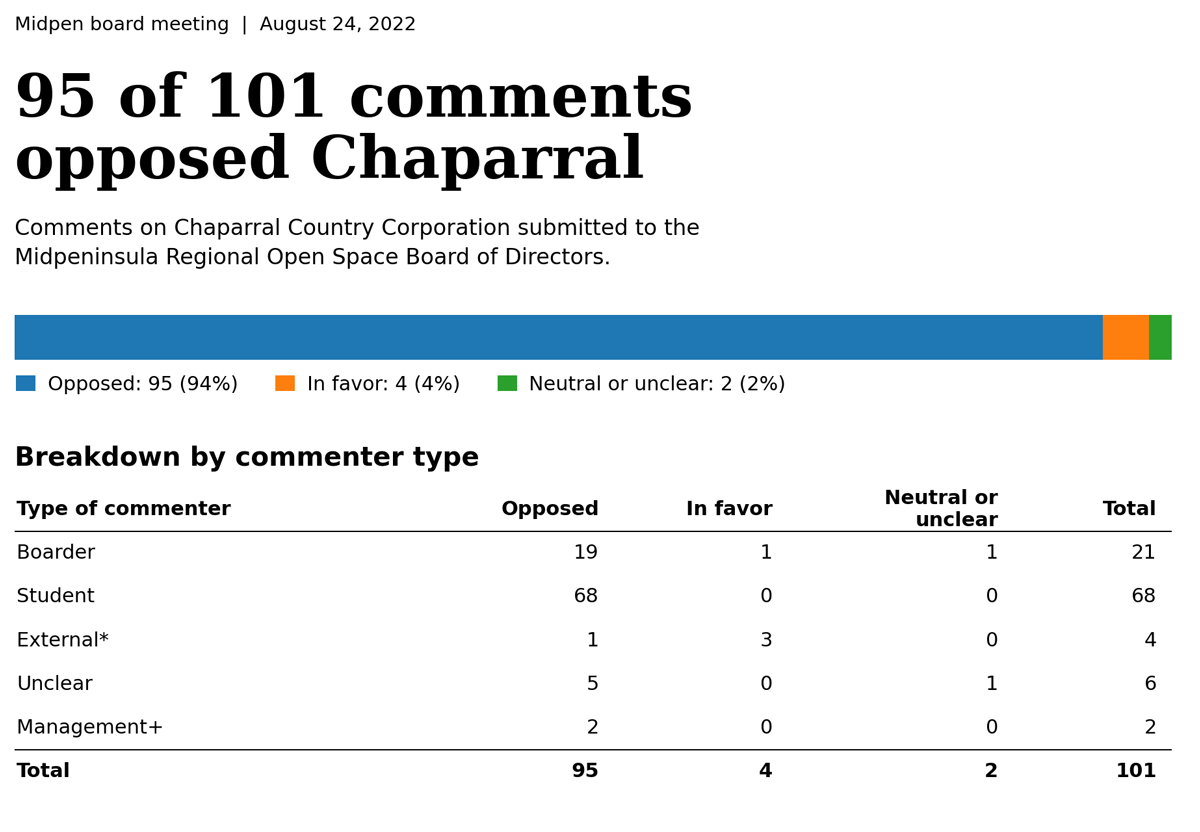
I’ve raised multiple concerns with Midpen about horse welfare and children’s safety at Bear Creek Stables. I first started paying attention to Midpen in 2022, when the Board awarded a concessionaire contract to run the stables over the objections of more than 90% of public commenters. True to the warnings sent in, that tenure was short-lived and fraught with problems, including the shutdown of the concessionaire’s lessons and camps over insurance issues, and the removal of its horses from the stables in the middle of an ongoing Animal Control investigation into suffering horses. That story deserves its own article, and, to quote one of the Midpen directors, “it’s coming.”
There is a 2016 Instagram video taken at Bear Creek Stables that I can’t unsee. A pickup truck is bouncing down a rough dirt road toward the main barn with a load of children in the back. The truck bucks over the road and the children bounce with it. Some aren’t wearing helmets. As the driver bounces past, they look toward the camera instead of the road. As I watched the video, I pictured the Midpen logo pasted over the driver’s face.
When Midpen acquired the stables as part of a larger land purchase in 1999, the agency’s acquisition report said the facility was already in bad shape. A quarter of a century later, at a May 14, 2024 board meeting, General Manager Ana Ruiz told the Board the stables were “in very poor condition” and warned that without repairs soon, “we will see buildings and the facilities structurally and functionally fail.”
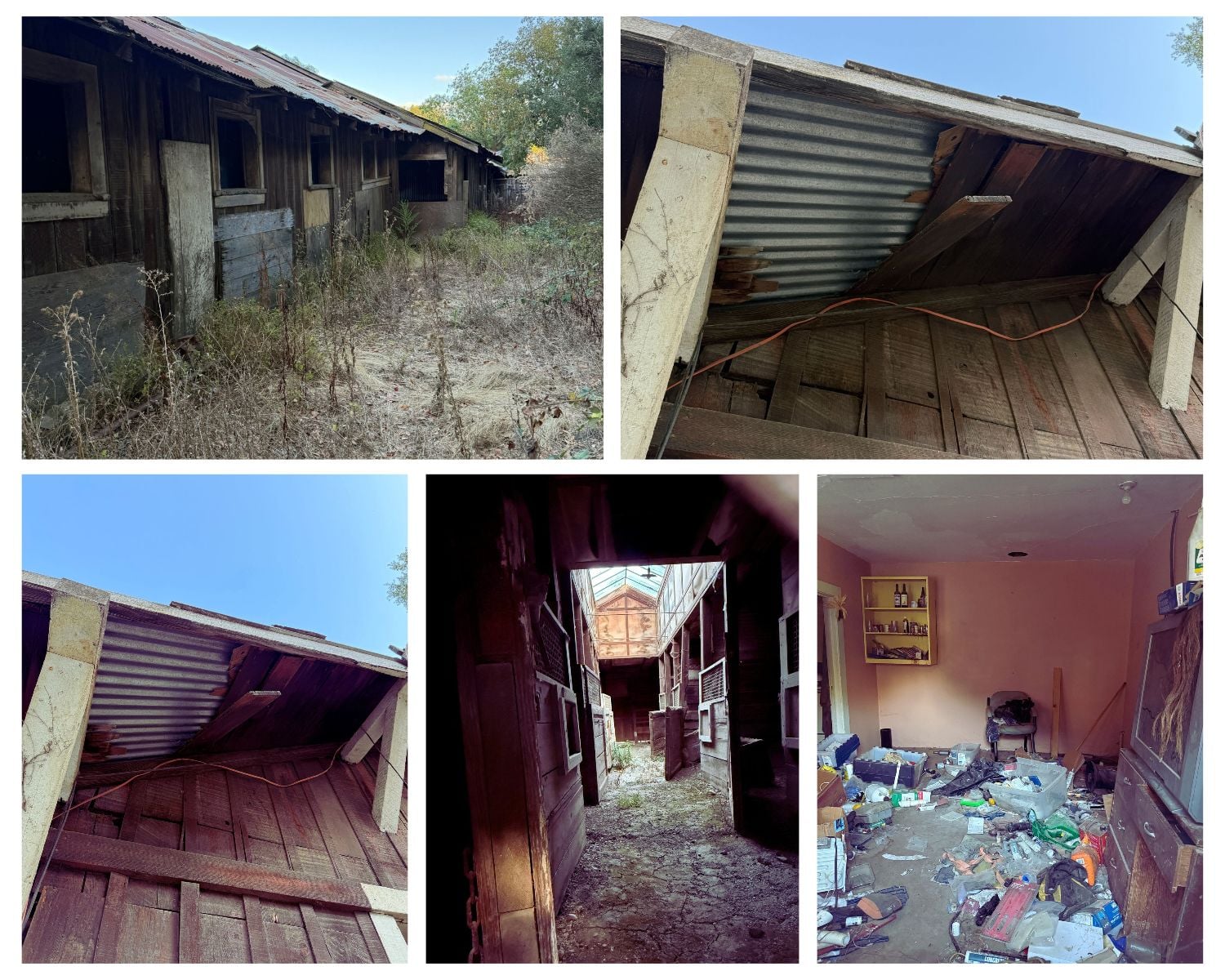
When Measure AA passed in 2014, Midpen promised taxpayers it would use some of that $300 million bond to invest in long-needed repairs to bring the stables up to code and provide public access. Since then, as Ruiz also said, the stable facilities got only “very basic and minimal repairs over time.” The repair plan is still stuck in a five-year effort just to get a complete Use Permit application to the County, a permit the County told Midpen was needed back in 2015, after the agency proposed expanding public programs to add riding lessons, camps, trail rides, 4-H programs, environmental education and other public activities.
Midpen’s own plans call for tearing down much of the lower area of the stables, the part where the Board’s 2024 plan for the stables’ future limits public programs. The breezeway barn, the old hay barn and an addition to the main barn are all slated for demolition. The only structure Midpen plans to keep is the main barn, built in 1917, but it will not renovate it under the current Board-approved phases of the repair plan. The architectural plans Midpen submitted to the County mark the main barn with a note that says “SEISMIC RISK OF COLLAPSE” and call for limiting access, removing portions of the structure and surrounding it with an eight-foot fence, set back up to 20 feet, “to protect site users from potential collapse.”
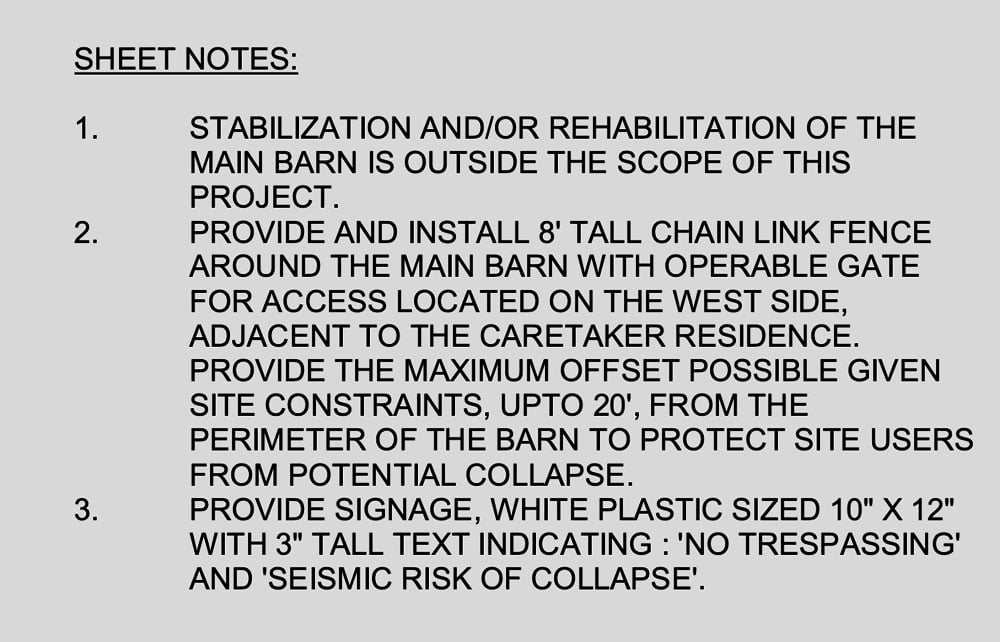
At the same time those plans were first filed with the County in 2021, the tack room was inside that barn. Children walked in twice every lesson to get and return their saddles and bridles. The protective fence is still not built.
A gate in front of the public
When the concessionaire served a longtime boarder and volunteer with an eviction notice in late 2023, they had nowhere to go. They told the Board there had been “no warning” and “no process for me to appeal,” and that they believed it was retaliation for speaking up for another boarder who had reported hazardous conditions. The boarder reported that the concessionaire had told them it had “no interest in discussion or debate in the eviction process.” Midpen’s position was that this was a matter between the boarder and the concessionaire. The boarder disagreed and asked for Midpen’s ombudsperson to help mediate.
When a member of the public disagrees with a decision by Midpen staff, the ombud program is supposed to be where they can turn. It is meant to give people a neutral hearing about a narrow list of issues they may have with the agency, but requests must first get past staff, who decide what reaches the ombudspersons. Requests staff determine to be “outside the purview of the Ombudsman program” never do. The boarder’s request was denied, even after they received an email saying it had been forwarded, and despite a 2021 ask by the Board of Directors to make it available to boarders. At the February 14, 2024 Board meeting, one of the ombudspersons told directors he never saw the two requests filed the year before, and that the case he had worked on “was closed without my permission.” Directors added their own confusion. One didn’t realize Midpen had three ombudspersons. Another said a constituent had been told Midpen didn’t have one. With all of that in front of them, the Board didn’t fix the process. It voted 6-0 to change one word, so the Board would “receive” the report instead of “accept” it.
“Trust the staff” over process
In April 2026, two directors asked to put staff’s own timing for pre-construction surveys at Bear Creek Redwoods Preserve in writing, because the environmental document had older language that directly conflicted with the updated survey window. Director Curt Riffle objected that “staff has already told us how they’re gonna implement this,” and he and two other directors voted no. The irony is that Riffle ended up voting against the staff recommendation itself, because the motion to approve it included Director Karen Holman’s fix to the conflicting survey window.
A good governing body has to question staff when their explanations don’t hold up, or, in this case, fix conflicts in its own policy and regulatory documents. That shouldn’t devolve into a question of whether directors trust staff, and in this case it did. Riffle now chairs the committee rewriting the code of conduct.
From “shall” to “should”
These are troubling examples of moments when the Board had a chance to address a serious issue, like public access to the ombud program, and the discussion devolved into a vote on semantics. Now the Board is set to do it again with its own code of conduct.
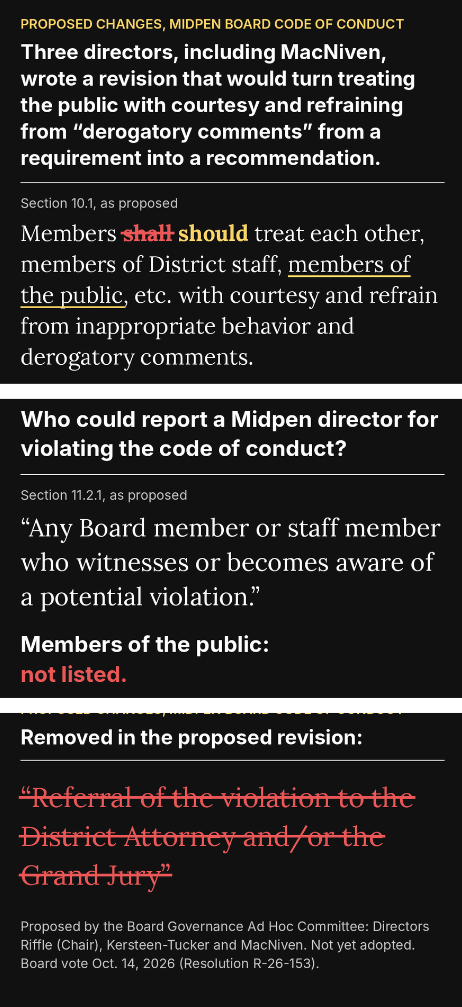
The rewrite drafted by Director Riffle, Director MacNiven and Board President Kersteen-Tucker would change the code from saying directors “shall” treat the public with courtesy, which means they must, to saying they “should,” which only recommends it. It would also list only Board members and staff as the people who can report a violation. Midpen’s volunteers are required to follow the code of conduct too, but the rewrite gives them no way to report a violation. Only directors and staff get that. Under that rewrite, the public would still have to rely on someone inside the agency to initiate the complaint process.
The rewrite adds internal disciplinary options, including censure, but removes the old code’s explicit reference to District Attorney and Grand Jury referrals. It gives directors a more elaborate process for handling complaints about one another while leaving the public without a defined route to initiate one. After hearing how staff controlled access to the ombudsperson, the Board should understand why a process controlled entirely from within is not enough.
Strong governance, not a weaker code
More than three months after it opened on July 8, 2026, Santa Clara County’s code enforcement investigation into Bear Creek Stables (VIO26-0300) is still ongoing. Among other issues, the County has been investigating whether Midpen has stayed within the narrow limits of the stables’ grandfathered use, which the County’s only determination, in 2000, found was horse boarding only. Since the County rezoned the area to rural residential in the mid-1970s, running public riding lessons and horse camps there has required a Commercial Stable Operation Use Permit, unless continuous legal use can be documented going back more than 50 years. In 1999, three separate Midpen documents drove home the point that horse boarding was the only use at the stables: the acquisition report, the agenda report approving the rental contract and the rental contract itself.
That is where Midpen needs strong governance fueled by a strong code of conduct. Getting the stables back on track means making the long-needed repairs, finishing a Use Permit application the County can actually review, and only then opening the stables to the public. That takes a Board that puts children’s safety first and makes sure no child is sent into a derelict barn its own plans say could collapse.
Instead, the Board is preparing to soften the code intended to hold its members to a high standard of care toward the public Midpen says it serves. The public has not been asking directors to lower their obligations. It has been asking them to meet them.
Good governance needs a strong code of conduct, not a weaker one.
Related articles
- Midpen Open Space and the Harm of Repeat Disturbance
- Timing Matters: Spring Mowing, Nesting Birds, and Native Wildflowers at Bear Creek Redwoods Preserve
References
County of Santa Clara, Department of Planning and Development. (2026, July 8). [Code enforcement case record VIO26-0300, Bear Creek Stables]. Accela Citizen Access. Case record
County of Santa Clara, Department of Planning and Development, Planning Office. (2015, August 24). Use permit pre-application (File No. 5814-15PA) [Letter to Gretchen Laustsen]. Pre-app-correspondence
County of Santa Clara, Environmental Resources Agency, Planning Office. (2000, November 14). Status of horse boarding operation at 19100 Bear Creek Road (File No. 5814-26-46-00Z1) [Letter to Glenda J. Smith].
GIS Certification Institute. (n.d.). Code of ethics.
Midpeninsula Regional Open Space District. (1999a, June 24). Approval of exercise of option to purchase of real property of lands of the Arlie Land and Cattle Company; conveyance of fee interest in upper portion of the property to Peninsula Open Space Trust, and approval of purchase agreement therefore; approval of lease and management agreement between District and Peninsula Open Space Trust regarding upper portion of the property; approval of proposed mitigated negative declaration and mitigation monitoring program in accordance with California Environmental Quality Act; adoption of preliminary use and management plan and naming property an addition to Bear Creek Redwoods Open Space Preserve; approval of residual timber rights option agreement with Gregory Demers and termination of residual timber rights option agreement with Arlie Land and Cattle Company; approval of letter agreement with Arlie Land and Cattle Company regarding certain terms and conditions of exercise of option; and authorization for the Board President and General Manager to execute all documents necessary or appropriate to implement and/or close these transactions, including escrow documents (Report No. R-99-93). BCR Purchase Board Report
Midpeninsula Regional Open Space District. (1999b, December 15). Tentative adoption of amendment to the preliminary use and management plan for Bear Creek Redwoods Open Space Preserve to continue horse boarding facility use and approval of Bear Creek Stables rental agreement (Report No. R-99-159, including the attached month-to-month rental agreement).
Midpeninsula Regional Open Space District. (2016, February 24). Bear Creek Stables site plan (Report No. R-16-20).
Midpeninsula Regional Open Space District. (2022a, August 24). Approval of a multi-year agreement with Chaparral Country Corporation as the recommended concessionaire for Bear Creek Stables located in Bear Creek Redwoods Open Space Preserve (Report No. R-22-99).
Midpeninsula Regional Open Space District. (2022b, August 24). Board of Directors [Meeting agenda and recording].
Midpeninsula Regional Open Space District. (2024a, May 14). Bear Creek Stables capital maintenance and repair project update and confirmation on next steps (Report No. R-24-58).
Midpeninsula Regional Open Space District. (2024b, February 14). February 14, 2024: Midpeninsula Regional Open Space District Board of Directors meeting [Video]. YouTube.
Midpeninsula Regional Open Space District. (2024c, January 10). January 10, 2024: Midpeninsula Regional Open Space District Board of Directors meeting [Video]. YouTube.
Midpeninsula Regional Open Space District. (2024d, May 14). May 14, 2024: Midpeninsula Regional Open Space District Board of Directors meeting [Video]. YouTube.
Midpeninsula Regional Open Space District. (2024e, February 14). Ombudspersons summary report for activities from January through December 2023 (Report No. R-24-20).
Midpeninsula Regional Open Space District. (2025a, October 22). Amendment to the interim, short-term Bear Creek Stables services agreement with the Friends of Bear Creek Stables and an update on Phase 0 site improvements (Report No. R-25-134).
Midpeninsula Regional Open Space District. (2025b, October 22). October 22, 2025: Midpeninsula Regional Open Space District Board of Directors meeting [Video]. YouTube.
Midpeninsula Regional Open Space District. (2026a, April 8). April 8, 2026: Midpeninsula Regional Open Space District Board of Directors meeting [Video]. YouTube.
Midpeninsula Regional Open Space District. (2026b, October 14). Revisions to Board Policy 6.07 Code of Conduct Policy and Board Policy 1.06 Board Officers, and formation of an Ad Hoc Committee to support the preparations of a future Board Governance Workshop (Report No. R-26-153) [Staff report and proposed policy revisions].
Page & Turnbull. (2025, June 12). Bear Creek Stables: Main barn plan—site protection (Sheet A2.11; Project No. 385) [Architectural drawing]. Midpeninsula Regional Open Space District. PLN21_173_R2_Plans
U.S. Bureau of Labor Statistics. (2026a, August 27). Cartographers and photogrammetrists. Occupational Outlook Handbook. U.S. Department of Labor. Bureau of Labor Statistics
U.S. Bureau of Labor Statistics. (2026b, August 27). Geographers. Occupational Outlook Handbook. U.S. Department of Labor.
