
Two oak forests separated by hundreds of miles and dramatically different elevations share an unusual characteristic: many of their oldest trees began growing during the same period.
A new study used radiocarbon dating to determine the ages of ancient oak trees growing on Montecristo Island in the Tyrrhenian Sea and in the high-elevation forests of the Aspromonte mountains in southern Italy. Despite their very different environments, both forests showed a similar age pattern, with many of the oldest trees becoming established between about 1400 and 1650.
That period coincides with the centuries following the Black Death and subsequent plague outbreaks that affected Italy. The researchers suggest that declining populations reduced activities such as farming, grazing, and wood harvesting in many areas, creating conditions that allowed forests to regenerate and expand.
The similarity between the two sites is one of the study’s most notable findings. Montecristo is a Mediterranean island with relatively mild growing conditions. Aspromonte is a mountainous landscape with colder temperatures, shorter growing seasons, and a history of intensive human use. Finding a similar pulse of tree establishment in both locations points to a regional process rather than a local event.
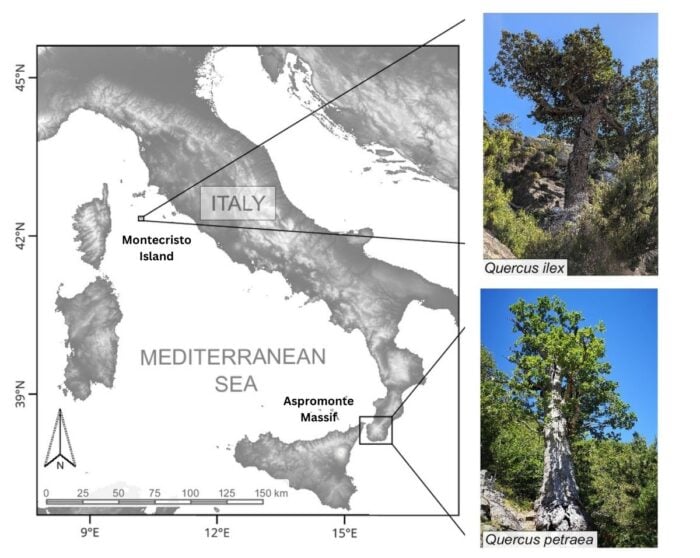
The forests did not recover in exactly the same way. On Montecristo, tree establishment increased rapidly, helping create the dense oak forest described in historical accounts from later centuries. In Aspromonte, recovery unfolded more gradually, reflecting the challenges of a harsher mountain environment.
The dating results also challenge a common assumption about old trees. The largest trees were not always the oldest. Some ancient oaks grew slowly over centuries and remained smaller than younger trees that experienced faster growth.
Among the trees dated in the study were holm oaks approaching 1,000 years in age, placing them among the oldest known flowering trees in the temperate zone. The research also found that trees of similar ages can vary greatly in size, reinforcing the idea that diameter alone is a poor indicator of age.
More than 600 years after the plague years, the age structure of these forests may still preserve evidence of how a major demographic shift altered the Italian landscape.
Italian Ancient Oaks Study:
Piovesan, G., Baliva, M., Biondi, F., Palli, J., Quilghini, G., Quarta, G., Siclari, A., Chiarucci, A., Cannon, C. H., & colleagues. (2026). Ancient oaks reveal rewilding of Mediterranean forests after the Black Death. Proceedings of the National Academy of Sciences, 123(24). https://doi.org/10.1073/pnas.2529341123
