
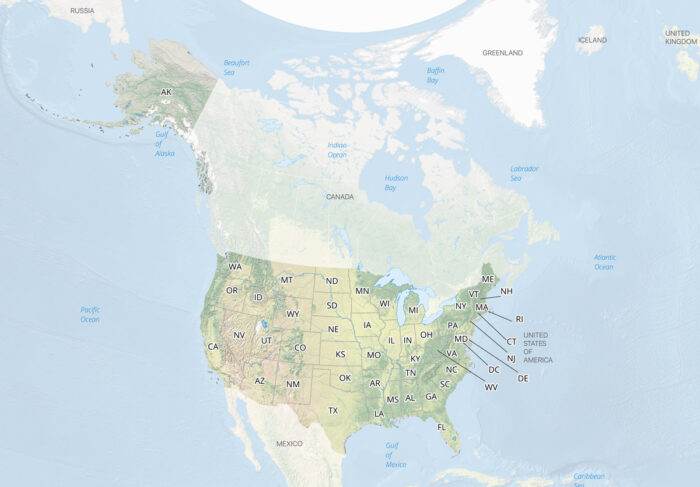
Every U.S. state has at least one geographic feature or characteristic that sets it apart. From mountains, deserts, and coastlines to political boundaries and unique settlement patterns, these facts showcase the geography that makes each state unique.
Unique geography facts by state
Each state has a geographic story to tell. Browse the states below to discover what makes each one unique.
Alabama • Alaska • Arizona • Arkansas • California • Connecticut • Colorado • Delaware • Florida • Georgia • Hawaii • Idaho • Illinois • Iowa • Kansas • Kentucky • Louisiana • Maine • Maryland • Michigan • Montana • South Carolina • South Dakota • Tennessee • Texas • Vermont • Virginia • Washington • West Virginia • Wisconsin • Wyoming
Alabama
Alabama is the only U.S. state that contains all of the major natural resources needed to produce iron and steel: iron ore, coal, and limestone. This unusual combination of resources helped Birmingham emerge as one of the nation’s leading steel-producing cities during the late nineteenth and early twentieth centuries.
Alaska
Alaska is the only U.S. state that borders both the Arctic Ocean and the Pacific Ocean. Spanning more than 20 degrees of latitude, it stretches from temperate rainforests in the southeast to Arctic tundra along its northern coast, encompassing a greater range of climate zones than any other state.
Alaska is only state that extends into the Arctic Circle, boasting the highest peak in North America, Mount McKinley.
Alaska is the only U.S. state that is both the northernmost and the westernmost.

Arizona
Arizona is the only U.S. state that contains a segment of all four North American deserts: the Great Basin, Sonoran, Chihuahuan, and Mojave deserts. This convergence of desert ecosystems does not occur in any other state.
The convergence of four desert ecosystems creates remarkable biodiversity. Plant communities range from towering saguaro cacti in the Sonoran Desert to Joshua trees in the Mojave Desert and piñon-juniper woodlands at higher elevations.

Arkansas
Craters of Diamonds State Park in Arkansas is the only park in the United States where visitors can mine for diamonds and keep them.
California
California is the only state with both the highest (Mount Whitney) and lowest (Death Valley) points in the contiguous United States. California’s dramatic elevation range spans more than 14,000 feet (4,300 meters) between Mount Whitney and Badwater Basin, one of the greatest elevation differences found within any U.S. state.
California is the only state that has hosted both the Summer and Winter Olympics. The state has hosted three olympics: Summer Olympics in Los Angeles in 1932, Summer Olympics in Los Angeles in 1984, and the Winter Olympics in Squaw Valley in 1960.
Connecticut
Connecticut is the only state in the United States where counties have no independent government and are merely geographical regions on a map. Legislation passed in 1959 and 1961 removed the duties and functions of the state’s eight counties.
Colorado
Colorado is the only U.S. state where every point lies at least 1,000 meters (3,280 feet) above sea level. Its high average elevation reflects the state’s position within the Rocky Mountains and Colorado Plateau, giving Colorado the highest mean elevation of any state.
Delaware
Delaware is the only state that still uses the sub-county geographic subdivision of “hundreds”. A holdover from when Delaware was a British colony, a hundred was traditionally an area that could support approximately 100 families. Delaware is the only state where the term “hundred” remains in use today. Although hundreds no longer function as local governments, they remain part of legal property descriptions and tax records, making Delaware unique in preserving this colonial-era geographic division.
Florida
Florida is the only state that has a tropical climate in parts of its territory and is the closest state to the equator in the continental U.S. Florida’s location between the Gulf of Mexico and the Atlantic Ocean, combined with its subtropical and tropical climates, supports ecosystems found nowhere else in the continental United States, including mangrove forests and extensive coral reefs.
Georgia
Georgia is the only U.S. state that is home to the geographic region known as the Ridge-and-Valley Appalachians, where ridges and valleys run parallel to each other. This unique topographical feature, located in the northwestern part of the state, distinguishes Georgia from the other U.S. states.
Hawaii
Hawaii is the only state that is an archipelago, a chain of islands situated in the central Pacific Ocean. Consisting of 137 islands, including eight main islands, the Hawaiian archipelago spans over 1,500 miles. The formation of the Hawaiian Islands is attributed to volcanic activity, with several active volcanoes still present on the Big Island.
Hawaii is also the only U.S. state that does not share a land boundary with another state or country. As an archipelago, Hawaii is the only state entirely surrounded by an ocean, the Pacific Ocean.

Idaho
Idaho has the only U.S. state seal designed by a woman, which was designed by Emma Edwards Green in 1891.
Illinois
Illinois is the only U.S. state that has a majority of its land covered by a specific type of soil, known as Drummer silty clay loam. It’s the state soil and represents the extensive prairie lands that once covered Illinois. Drummer silty clay loam formed beneath ancient prairie grasslands over thousands of years and is considered one of the world’s most productive agricultural soils, helping make Illinois a leading corn and soybean producer.

Iowa
Iowa’s eastern border follows the Mississippi River while its western border follows the Missouri and Big Sioux Rivers. No other state has both its eastern and western boundaries defined almost entirely by rivers
Kansas
Kansas is the only state to have researchers scientifically prove that it’s “flatter than a pancake”. In a 2003 study by geographers at Texas State University and Arizona State University, a topographical analysis found that the flatness of the state is indeed greater in some areas than that of a pancake. While the study was intended as a humorous response to the saying “flat as a pancake,” it also highlighted how subtle differences in topography can be measured using geographic analysis and digital elevation models.

Kentucky
Kentucky is the only U.S. state with a cave system that extends longer than 400 miles. Kentucky has a unique geographical feature known as the Mammoth Cave System, which is the longest known cave system in the world. With more than 400 miles (640 kilometers) of explored passageways, this extensive cave system is located in the heart of Kentucky and is a World Heritage Site.

Louisiana
Louisiana is the only state in the U.S. with political subdivisions termed parishes, which are equivalent to counties. Louisiana’s parishes reflect the state’s French and Spanish colonial history, when local administrative boundaries were organized around church parishes rather than counties. Today, Louisiana’s 64 parishes function in much the same way as counties elsewhere in the United States.
Maine
Maine is the only state that shares its border with only one other U.S. state (New Hampshire) and has the easternmost point in the contiguous United States.
Maine is the only U.S. state with a one-syllable name.
Maryland
Maryland is the only state without a natural lake.
Michigan
Michigan is the only state that consists of two peninsulas, the Upper and Lower Peninsulas, separated by the Straits of Mackinac.
Michigan is the only state with a floating post office, the J.W. Westcott II.
Michigan is the only state with coastlines on four of the five Great Lakes: Michigan, Superior, Huron, and Erie, and has the longest freshwater coastline in the United States. Surrounded by four Great Lakes, no location in Michigan is more than about 85 miles (137 kilometers) from one of the lakes, contributing to the state’s extensive freshwater coastline and maritime climate.

Montana
Montana is the only producer of palladium & platinum in the United States. Palladium is a chemical element used for dental alloys and automobile catalytic converters. Platinum is also used for catalytic converters and is a favored metal for jewelry.
South Carolina
South Carolina is the only state with a large-scale commercial tea plantation.
South Dakota
South Dakota is the only state that houses the geographic center of the entire U.S., near the town of Belle Fourche. The geographic center near Belle Fourche represents the center of the fifty states by area. Different methods of calculating the nation’s geographic center, such as using only the contiguous states or measuring population instead of land area, produce different locations.

Tennessee
Tennessee is one of only two states that is bordered by eight other states: Kentucky, Missouri, Arkansas, Mississippi, Alabama, Georgia, North Carolina, and Virginia. Missouri also borders eight other states: Arkansas, Illinois, Iowa, Kansas, Kentucky, Oklahoma, Tennessee, and Nebraska. What makes Tennessee unique is that it is the only state that borders three separate U.S. regions: the South (Alabama, Mississippi, Georgia), the Midwest (Arkansas, Missouri), and Appalachia/East (Kentucky, Virginia, North Carolina). Tennessee’s location places it at the crossroads of several major geographic regions, from the Mississippi Alluvial Plain in the west to the Appalachian Mountains in the east. This transition contributes to the state’s remarkable diversity of landforms, ecosystems, and climates.
Texas
Prior to becoming the 28th state in 1845, the region that is now Texas was governed by six different sovereign powers. The phrase “Six Flags over Texas” reflects this unique political geography, commemorating the successive rule of Spain, France, Mexico, the Republic of Texas, the Confederate States, and the United States. Texas is also the only state whose current state flag, the Lone Star Flag, served as the official national flag of an independent republic before statehood.
While Hawai‘i also has a similar flag to the one designed for the Kingdom of Hawai‘i, it was not officially adopted as the national flag of the Republic of Hawai‘i in the same way Texas’s Lone Star Flag served as the official flag of an independent nation.
Texas is the only state that contains portions of four major physiographic regions: the Gulf Coastal Plain, Interior Lowlands, Great Plains, and Basin and Range Province. This diversity contributes to the state’s wide range of landscapes, from coastal marshes to deserts and mountains.
Vermont
Vermont’s strict building traditions and mountainous landscape have helped preserve one of the nation’s least-developed skylines, with no buildings exceeding 124 feet (38 meters) in height.
Virginia
Virginia is the only state entirely within the area commonly defined as Appalachia, and it is almost entirely covered by mountainous terrain.
Washington
Washington is the only U.S. state named after a president. Originally proposed as the Territory of Columbia, the name was changed to Washington in 1853 to avoid confusion with the District of Columbia.
West Virginia
West Virginia is the only U.S. state that lies entirely within a mountain range.
West Virginia is the only state created by seceding from a Confederate state.

Wisconsin
Wisconsin is the only state with an official state microbe, Lactococcus lactis, used in cheese making.
Wyoming
Wyoming is the only state in the U.S. with a population under 600,000 as of the 2020 census. Wyoming’s combination of high elevation, rugged mountain ranges, arid basins, and extensive public lands has limited large-scale urban development, contributing to its status as the nation’s least populous state.
This article was originally published on August 12, 2023 and has since been updated.
