
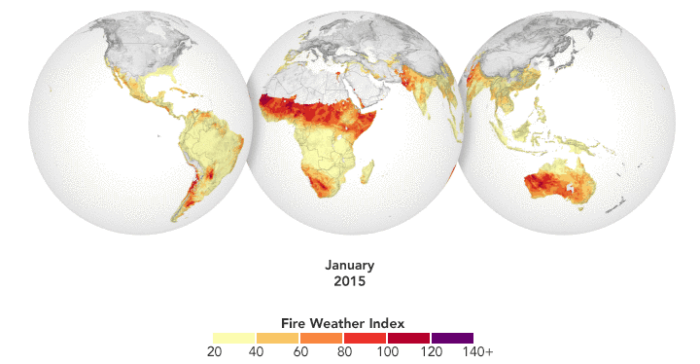
Wildfires are becoming larger, more frequent, and more destructive in many parts of the world. While no model can predict exactly where every fire will start or how it will spread, advances in GIS, satellite imagery, and artificial intelligence are helping scientists forecast fire risk with increasing accuracy.
Forecasting both the likelihood and intensity of wildfires is important for protecting communities, managing natural resources, and understanding how climate change is influencing fire behavior. Recent wildfire seasons have also highlighted the dangers of smoke, which can travel hundreds of miles from active fires and degrade air quality far from where the fires are burning.
Satellite observations play a critical role in monitoring fire conditions and identifying areas where weather and vegetation create favorable conditions for wildfire ignition. These observations feed forecasting models that estimate where fires are most likely to occur. Techniques integrating artificial intelligence and, in some cases, combining wildfire and smoke forecasting are likely to be increasingly important in an era where large-scale wildfires are becoming the norm.
Using remote sensing data to forecast wildfires
NASA’s Global Fire Weather Database (GFWED), which provides wind, temperature, and humidity data that can then be used with GIS or remote sensing software to forecast where fires could begin, continues to be an important global database used for forecasting wildfires.

GFWED uses satellite-based precipitation measurements made in near real-time that are applied to forecast the probability that a wildfire could begin in a given area. The model produces a fire danger index that identifies areas where wildfires are more likely to ignite.
The model uses historical fire patterns to identify areas where wildfires are most likely to spread. For example, wildfire risk depends not only on how dry an area is but also on factors such as changing wind speeds. By combining multiple environmental variables, the model provides a more complete regional assessment of fire danger. [1]
Using artificial intelligence to forecast and map wildfire probability
Machine learning and artificial intelligence techniques analyze patterns across satellite imagery, weather conditions, topography, and vegetation to estimate where wildfires are most likely to start and spread. Many of these approaches use data from sensors such as the Moderate Resolution Imaging Spectroradiometer (MODIS).
In one type of model, factors such as humidity, wind speed, rainfall, elevation, slope, and normalized difference moisture index (NDMI) are used to predict where wildfires could start. Among current machine learning approaches, random forest models have achieved prediction accuracies approaching 88% in some studies.[2]

There are, however, other approaches that have been developed that utilize both human and natural factors in assessing fire risk.
For instance, using MODIS data, a learning algorithm using expectation-maximum methods was used to evaluate a series of inputs from different regions. Bayesian networks and GIS were used to evaluate regional factors of different inputs influencing fires from historical data. This was applied in Eswatini and it was found that both land tenure and land cover conditions were shown to be major reasons for fire, where the model was able to have accuracy of over 93% in forecasting fires.
Satellite observations are used to train these models, allowing them to recognize patterns associated with past wildfires and identify similar conditions that could lead to future fire activity. [3] Increasingly, newer models are looking at spatial resolution, particularly localized factors that determine how a fire spreads.
In this case, a Location-aware Adaptive Normalization layer (LOAN) is used where dynamic variables (e.g., weather conditions) are separated from more static variables (e.g., topography); this helps the deep learning convolutional neural network better forecast how wildfires evolve in a given and more precise area.[4]
Spatio-temporal 2D/3D convolutional neural networks allow spatial and temporal variables to be split and applied for forecasting in very localized areas. Such results demonstrate that deep learning is now beginning to become a promising way in which wildfires can be forecasted. Deep learning approaches are much more data intensive and this means this will require much more precise monitoring techniques.
Data may need to better capture both satellite-based and local ground-based observations if deep learning models are to have high levels of accuracy in forecasting likely pathways of wildfire spread.
Understanding human influences on wildfire risk
Other methods have tried to combine GIS, remote sensing and interviews with local experts to better understand fires. In these cases, it has been observed in some regions, such as the Mediterranean area, a high percentage of fires are started by human factors.

Combining Earth observation data with information about human activities, such as land management and deliberate ignitions, provides a more complete understanding of wildfire risk than environmental data alone. This helps to produce an accurate understanding of human-environment risk factors in fire occurrence.[5]
How wildfire forecasting is evolving
Many national forest services use standardized models to help predict and manage wildfires. Software tends to use fuel and moisture conditions, simulating surface and fire rate and spread.
In the United States, the standard U.S. Department of Agriculture Forest Service model is BehavePlus, a simulation-based approach used to forecast wildfire spread.. Increasingly, researchers have been arguing that AI-based forecasting tools may provide better results.
Factors that incorporate natural and human factors are likely to be how tools continue to evolve. In particular, machine learning approaches can also be flexible in how incorporating different factors based on seasonal variation could help them outperform some existing statistical or simulation-based approaches.[6]
Forecasting the spread of wildfire smoke
Scientists are not just concerned about forecasting wildfire spread. Greater attention has now been given to forecasting the spread of smoke, given that smoke can travel much further than fires and can affect the health of millions of people through the dispersion of fine particle matter.
The High-Resolution Rapid Refresh Smoke (HRRR-Smoke) is an experimental wildfire smoke prediction model that is an extension of NOAA’s existing HRRR weather model predicting rain, wind, and thunderstorms. This model incorporates real-time data from the Joint Polar Satellite System’s Suomi-NPP and NOAA-20 polar satellites, in addition to data from NASA’s Terra and Aqua satellites.

In the United States, the National Weather Service uses the HYSPLIT-based system to forecast smoke drift and air quality. The model is essentially a dispersion forecasting tool that looks at transport, dispersion, chemical transformation, and deposition in simulating likely areas smoke could travel.[7]
Recent work has integrated this framework with a fire spread model, called ELMFIRE, that forecasts climate change impact studies as well as recent events. By combining fire forecasting techniques and inputs with plume and particle matter spread, the approach of integrating these models appears to yield very accurate results, comparable to HYSPLIT, without the need for having a lot of input data.
More specifically smoke spread can be forecasted at high accuracy levels by focusing on modeling where several large or key fires spread rather than focusing on a capturing a large number of current fires. Key fires can help outline important inputs in the atmosphere and weather conditions that drive smoke spread.[8]
This demonstrates how health officials as well as fire managers may be able to quickly obtain an idea of what areas are likely to face air quality issues as wildfires develop. Rather than waiting to get all needed wildfire data, officials may simply focus on some of the key fires to estimate which areas are likely to be affected by smoke.
Future directions in modeling and mapping wildfires
Wildfire modeling is now beginning to expand well beyond simulation and statistical methods by incorporating new forms of artificial intelligence techniques. Many of the older models are very accurate and useful in their forecasting capabilities, but deep learning methods can potentially help fill uncertainty gaps.
Moreover, with improved monitoring that combines satellite-based and ground-based methods, more localized models can be used to better forecast overall likely fire behavior.

This, however, suggests we will need far better monitoring that integrates the various levels of observation in order to use these more data-intensive deep learning models, which may remain a challenge for some time to come in many parts of the world. In other words, older fire models are likely to remain some of the best approaches until we can improve our data capture in many remote areas.
With health hazards of individuals far away from fires now also a major concern, future methods will likely integrate fire and smoke models more closely. Rather than focusing on areas immediately impacted by fires, models will look at a number of surrounding fires that may together shape air quality at continental scales.
Wildfire forecasting continues to improve as satellite observations, ground-based monitoring, and artificial intelligence become more tightly integrated. While no system can predict every fire, these advances are giving fire managers increasingly accurate tools for anticipating wildfire behavior, protecting communities, and reducing the impacts of smoke on public health.
References
[1] For more on fire forecasting using NASA’s GFWED, see: https://earthobservatory.nasa.gov/images/92367/forecasting-fire.
[2] For a recent study on using machine learning and artificial intelligence techniques on wildfires, see: Abdollahi A and Pradhan B (2023) Explainable artificial intelligence (XAI) for interpreting the contributing factors feed into the wildfire susceptibility prediction model. Science of The Total Environment 879: 163004. DOI: 10.1016/j.scitotenv.2023.163004.
[3] For more on using MODIS and learning algorithms for forecasting fires, see: Dlamini, W. M. (2011). Application of Bayesian networks for fire risk mapping using GIS and remote sensing data. GeoJournal,76(3), 283–296. https://doi.org/10.1007/s10708-010-9362-x.
[4] Eddin MHS, Roscher R and Gall J (2023) Location-aware Adaptive Normalization: A Deep Learning Approach For Wildfire Danger Forecasting. IEEE Transactions on Geoscience and Remote Sensing: 1–1. DOI: 10.1109/TGRS.2023.3285401.
[5] For more on understanding human factors and using remote sensing and GIS for fire risk understanding, see: Leone, V., Lovreglio, R., Martín, M. P., Martínez, J., & Vilar, L. (2009). Human Factors of Fire Occurrence in the Mediterranean. In E. Chuvieco (Ed.), Earth Observation of Wildland Fires in Mediterranean Ecosystems(pp. 149–170). Berlin, Heidelberg: Springer Berlin Heidelberg. https://doi.org/10.1007/978-3-642-01754-4_11.
[6] Wang W, Zhao F, Wang Y, et al. (2023) Seasonal differences in the spatial patterns of wildfire drivers and susceptibility in the southwest mountains of China. Science of The Total Environment 869: 161782. DOI: 10.1016/j.scitotenv.2023.161782.
[7] Stein AF, Draxler RR, Rolph GD, et al. (2015) NOAA’s HYSPLIT Atmospheric Transport and Dispersion Modeling System. Bulletin of the American Meteorological Society 96(12): 2059–2077. DOI: 10.1175/BAMS-D-14-00110.1.
[8] Melecio-Vázquez D, Lautenberger C, Hsieh H, et al. (2023) A Coupled Wildfire-Emission and Dispersion Framework for Probabilistic PM2.5 Estimation. Fire 6(6): 220. DOI: 10.3390/fire6060220.
This article was originally written on July 22, 2018 and has since been updated.
