
GIS and Geospatial Technologies
Articles focusing on the application of geographic information systems (GIS), geospatial technologies, remote sensing, LiDAR, and Global Positioning System (GPS). These technologies serve as critical tools for understanding and interacting with our physical environment. GIS allows for the mapping and analysis of spatial data Geospatial technologies refer to the various tools used to measure and analyze Earth’s lands and resources. Remote sensing provides a way to collect data from a distance, often via satellites or high-flying aircraft, and is commonly used for environmental monitoring and military applications.
GIS subcategories :
GIS Career | GIS Data | GIS Industry | GIS Learning | GIS Software | GPS | Remote Sensing | Spatial Analysis

Finding Low Tech Solutions for Nairobi’s Commuters
How do you help commuters navigate traffic when only 19% of the population owns a smartphone? IBM's Nairobi Labs has released a solution for commuters that uses low resolution traffic cameras to predict traffic patterns that are relayed via SMS.

How GIS is Being Used in Real Estate
What do GIS and real estate have in common? They both place a very high importance on location. For real estate ...

How GIS is Being Used to Help Native Americans
Native Americans use GIS for heritage/environmental protection, economic development, education, health, transportation, land use, and resource management.

Putting the Trees Back on the Map: How GIS is Helping Reforest South America
GIS is being used in creative ways – including covert spy tracking of illegal logging deep in the Amazon – to help put and keep trees back on South America’s map. The simplification of tools and availability of web systems has empowered technicians, NGOs, and governments alike to address corruption and illegal logging with transparent map-based monitoring.

GIS in Urban Planning
Frank Stafford, a graduate of Cambridge University with a background in Civil Engineering writes about why GIS is being used in Urban Planning.
QGIS versus ArcGIS
When considering which GIS desktop software to adopt, two of the most popular choices are Esri’s ArcGIS and Quantum GIS, ...

Finding Fossils with Remote Sensing
In the field of paleontology, finding fossils is often a substantial undertaking. Researchers usually have to assemble crews of up ...

GIS in Social Science: Mapping Social Capital Strength to Measure Organizational Efficacy
Here are four steps to use GIS in measuring social capital of social service programs, improving understanding of organizational effectiveness and conducting gap analysis.

Using Citizens to Map Atmospheric Particulates
By leveraging data from over 8,000 smartphone users, Dutch researchers successfully mapped atmospheric particulate levels.

Five Ways to Use GIS to Strengthen Your Nonprofit Fundraising
Here are five ways GIS can improve nonprofit fundraising, from refining prospect pools to partnerships, storytelling, and evaluation.

Smart Tree Logging with Remote Sensing
Treemetrics is using satellite imagery, UAV, and LiDAR to help forestry managers to map out forests in order to better assess the quality and value of their forests and to cut down on waste.

Searchable Database of Coordinate Systems
If you need a consolidated place to search for coordinate systems, EPSG.io is a place to start.

Optimizing Taxi Rides with HubCab
A project from MIT called HubCab analyzing 170 million taxi rides has found that sharing rides would reduce trips by 40%.

Planning with Google Earth – A Cost-Effective Alternative
Rick Tralies of the Natural Lands Trust, explains how organizations and non-profits can use Google Earth as a planning and mapping tool.

OWGIS – Open Source GIS Web Application
Standing for Open WebGIS, the developers of OWGIS describe it as an “OpenSource Java Servlets web application that creates WebGIS sites ...

Land Cover GIS Data from the European Space Agency
The European Space Agency has released land cover maps covering the 2000, 2005, and 2010 epochs. Developed by ESA’s Climate Change Initiative ...

3D Maps for the Blind
The Geospatial Information Authority of Japan (GSI) is developing low-cost technology to print 3D tactile maps for the blind.
Is the GIS Industry Splitting?
Matt Sheehan, from WebMapSolutions, shares some of the results from a survey asking, "is GIS splitting?"
How Does a Degree in GIS Affect How You Feel About Your Career?
Salary site payscale.com released the results of its 2014 college survey that looks at which college majors pay the best and are ...

New Detailed Map of the Ocean Floor
More than two-thirds of the earth’s surface is covered by deep oceans, yet researchers know one hundred times more about ...

Best Practices for Successful GIS Data Management
Lowell Ballard, Director of Geospatial Solutions for Timmons Group, shares some of his experience on managing GIS data and growing a GIS program.

CryoSat Shows Record Loss of Polar Ice
Scientists concerned about climate change are closely monitoring the thickness of polar sea ice. For many years, ice cover has ...
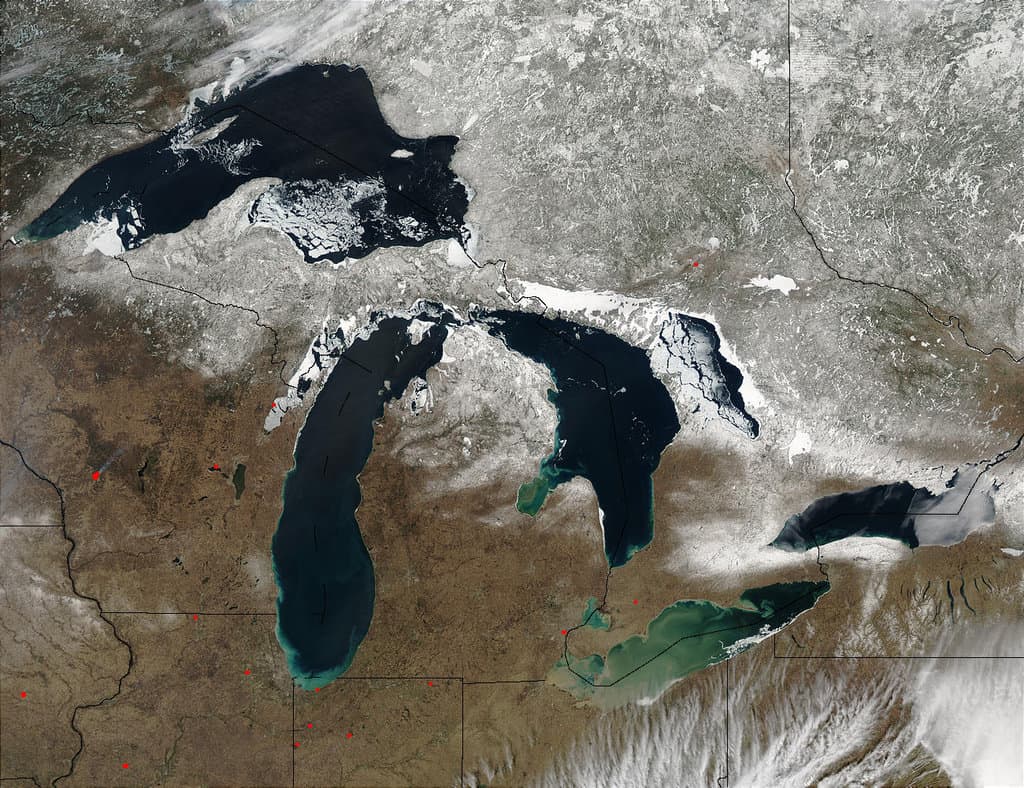
GLOWABO – Remotely Sensed Inventory of the World’s Lakes
A team of researchers used remote sensing techniques to calculate the number of lakes in the world.

Improved and More Realistic Minecraft Map of Great Britain
An improved Minecraft map of Great Britain has been released by the Ordnance Survey.

Measuring Small Variations in the Earth’s Gravity
The NASA–German Grace satellites were launched in May of 2002 in order to map variations in Earth's gravity field.

Measuring Carbon Dioxide and Nitrogen Dioxide Trends with Remote Sensing
Researchers from the University of Bremen published in Nature Geoscience the results of an effort to implement a top-down approach using data acquired remotely.