
GIS and Geospatial Technologies
Articles focusing on the application of geographic information systems (GIS), geospatial technologies, remote sensing, LiDAR, and Global Positioning System (GPS). These technologies serve as critical tools for understanding and interacting with our physical environment. GIS allows for the mapping and analysis of spatial data Geospatial technologies refer to the various tools used to measure and analyze Earth’s lands and resources. Remote sensing provides a way to collect data from a distance, often via satellites or high-flying aircraft, and is commonly used for environmental monitoring and military applications.
GIS subcategories :
GIS Career | GIS Data | GIS Industry | GIS Learning | GIS Software | GPS | Remote Sensing | Spatial Analysis

New GIS Dataset: Forest Carbon Stocks for the Western United States
Covering 11 states, this GIS dataset contains annual estimates of carbon stocks, fluxes, and productivity for Arizona, California, Colorado, Idaho, Montana, Nevada, New Mexico, Oregon, Utah, Washington, and Wyoming.

First Practice Exam for GISP Certification Released
A practice exam for the GISP certification has been release which contains 50 questions broken down in the six knowledge categories.

Changes to the National Land Cover Database
The National Land Cover Database is a GIS dataset that is seen as critical for monitoring the impact of fires, particularly increased wildfires in the West, general health of ecosystems, biodiversity monitoring, and increasing effects of climate change on land cover.

Gini Coefficient and GIS: Mapping Income Disparities
The Gini coefficient is a long-standing measure used by major organizations, such as the UN and government entities, to measure disparities between income and wealth in countries.

GIS and the US 2020 Census
The 2020 Census promises to be the most technically advanced census undertaken, where data, for the first time, will be mostly collected online.

Mapping Migration Based on Search Data
Researchers have create ways to map migration based on online searches of migrants as they prepare to leave their country of origin.

A Case Study on Converting a Geodatabase From ArcGIS for Use in QGIS
In this article Charles Altendorf outlines a method he developed to convert GIS data located in a geodatabase created in ArcGIS into open source data that can be used in QGIS.

Real-time Fire Mapping and Satellite Data
New satellites and improved image processing methods are better enabling the ability to provide real-time and near real-time mapping of wildfires.

Case Study: How Brindisi, Italy is Using GIS to Help Preserve its Ancient Architecture
The city of Brindisi, Italy deployed a solution from Pitney Bowes® that provides 80 to 90 percent faster performance, while dramatically improving the user-friendliness of maps and significantly reducing staff time dedicated to mapping.

First Data from NASA’s GEDI Program to 3D Map Forests
The first set of data that have returned have demonstrated GEDI is able to measure density of forests far better than previous satellite missions.

2018 NAIP Imagery
Aerial imagery covering 20 states has been added to the USDA's direct access site for NAIP imagery.

Free Synthetic Aperture Radar Handbook Available
This free handboo provides insight into how different Synthetic Aperture Radar (SAR) methodologies can be used for forest monitoring and biomass estimation.
GIS and Blockchain
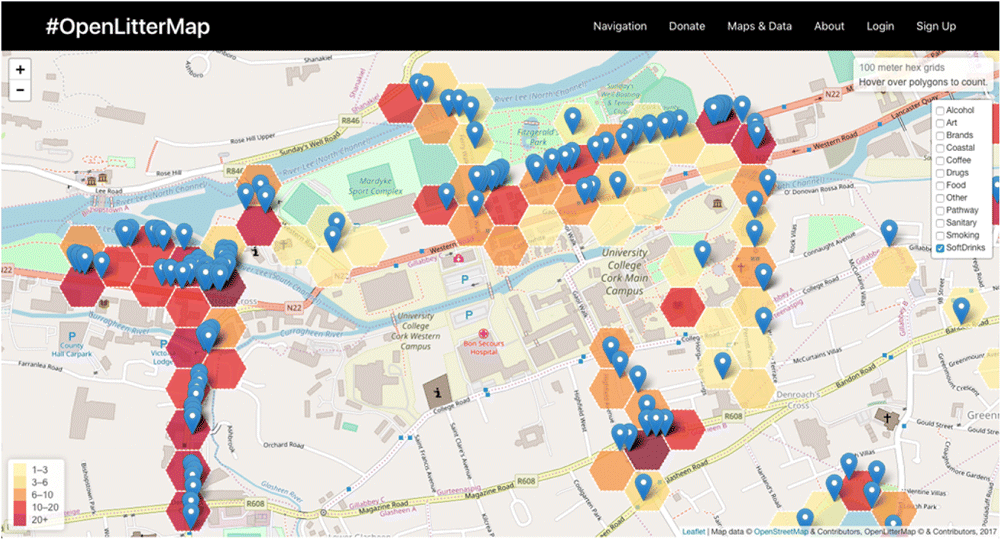
For Earth observation and GIS technologies, researchers have only recently begun contemplating what might be useful in applying blockchain technologies.

Next Generation Asset Management with iSTAR Pulsar
Danny Sullivan writes about how 360 imaging company NCTech's vehicle-mounted iSTAR Pulsar camera is being used by Icon Spatial as part of an asset management project for a major highway operator Australia.

Mapping Land Cover by Stacking Landsat Imagery
Landsat 8 is offered as free, open data, which has led to new innovation in methods to better utilize such data for time series and complex scenes that are sometimes obstructed by clouds or dust.

Using GIS to Analyze People’s Attitudes
GIS can help researchers analyze spatial data within social media posts in order to understand how people react to different features in their environment.

Latest Release of ArcGIS Online Introduces New Features and Enhanced Capabilities
Bernard Szukalski, Esri tech evangelist and product strategist, introduces new features and enhancements to the latest release of ArcGIS Online.

36,500 Satellite Images from RADARSAT-1 Now Available to the Public
The Canadian Space Agency and the Canada Centre for Mapping and Earth Observation have released RADARSAT-1's archive of 36,500 satellite images to the public.

Mapping School Performance and Inequality With GIS
With GIS, researchers can look at how effective schools are relative to spatial measures.

UK Satellite Data Now Available to Those Working in the Public Sector
The UK Space Agency has announced that its radar and satellite imagery data will be made available to those working in the UK public sector.

Microsoft Releases Canada Building Footprint Database to OpenStreetMap
Microsoft recently announced that it had released 12 million building footprints in Canada to the OpenStreetMap community.

Fire Danger Reanalysis Dataset
Researchers have made 38-years worth of global fire danger reanalysis available as an open dataset.

Topography of Australia’s Intertidal Zone Available as Open Data
The National Intertidal Digital Elevation Model (NIDEM) is the first 3D model of Australia's intertidal zone. It is available for downloading as an open source dataset from Australia's National Map portal.

Tutorial: Introduction to Geospatial Analysis in R
Explore the "Introduction to Geospatial Analysis in R" tutorial for lessons on importing files, layer management, and making maps.

Children’s Book: “Lindsey the GIS Specialist”
The next time a child asks you to explain what GIS is, you might want to read them this online book about Lindsey the GIS Specialist.

How Archaeologists Used GIS to Explore Sounds of the Past
Two archaeologists used GIS tools to model the ancient soundscape of New Mexico’s Chaco Canyon.